Showing posts with label high school. Show all posts

Sunday, June 2, 2013

Manipura- Third Chakra lesson plan


I demonstrated this lesson to two classes of high school students in the Bay Area. They responded excellently. I had to be very brief 35-40 minutes including drawing time. This lesson can be expanded and used as a brainstorming session for a larger project. It can also work as a part of other lessons using the other chakras.

Manipura, 3rd Chakra Lesson plan 
·           Objectives of the class. Students will be able to:
o   Understand what their third chakra is according to the Hindu philosophy
o   Demonstrate exercises that represent the chakra
o   Learn about artists working with memory, and body energy
o   Create a drawing based on their experience of the class (Draw body pose, laughter memory or image describing energy in the body)
·           Content standards (VPA California)
o   5.2 Create a work of art that communicates a cross-cultural or universal theme taken from literature or history.
o   2.5 Use innovative visual metaphors in creating works of art.
Introduction
·         I have found that a great way to get inspiration for art-making comes from getting to know yourself and who you are.
·         Today we are going to make some art, do body exercises, meditate and focus on one area of our bodies. As we go through this you want to pull and images that come to mind to use for you artwork later in the class.

Introduction meditation
·         Relax. Close your eyes (optional). Focus on your breath filling your lungs and bringing you warm or refreshing energy.
·         Imagine breathing in the energy from sky and letting it run through your body. (Alternate with pulling from the earth)
*Pass out flyers with images    


Energy and the Manipura
 The idea of energy flowing through your body has been around for a long time. Many cultures understand this and represented it in several ways. In Chinese medicine, it is known as Qi. It has been used to heal using Qigong and acupuncture. In my own culture a Curandera, is responsible for rubbing illnesses out of people through massage.
·         The chakra system originated from India around 1500-500 BC. It represented the complex paths and intersections that the body’s energy traveled through.
·         Chakra means wheel, so if you can think of these as places where energy gathers and swirls moving throughout your body. Each chakra is a place where energy gathers to perform its role.
·         Today we will work on the 3rd chakra. It is the yellow one (refer to handout).
o   The Manipura is commonly known as the Solar plexus. Like the sun its color is yellow. It deals with issues of willpower, ambition and action and is weakened by all forms of shame, embarrassment and self-consciousness. Physically, it supports your liver, pancreas, gallbladder, stomach and spleen.
·        How can you tell if you need to work on your chakra: Inbalance/ Balance:
o   Do you see yourself as powerless or too powerful OR Peaceful strength that is not too dominant or submissive
o   Do you have lots of different ways of shaming yourself OR are you Confient even if you make mistakes
o   Do you see the future as full of danger OR do you see future full of life, hope and that your dreams can come true
o   Do you are generally highly stressed and often comment to others how stressed and busy you are as a badge of honor. Or do you work towards growth and are future focused.
 Ask students: Does anyone relate to these and want to share? 


3rd Chakra Exercises
·           We are going to do another meditation and some exercises to have you feel your third chakra. These you can do with eyes open
o   Breath into your body as we did for the first meditation. Breath into your stomach letting it expand but still stay relaxed. Deep breath into stomach letting that whole area expand, back sides and front
o   Imagine you just had a delicious meal and your stomach is satisfied and full. Put your hands on your belly and rub your full stomach. Rub it really well with both hands.
o   Now I want you to think of your family, think of a funny memory. When was the last time you laughed so hard juice came out of your nose, or that time your friend farted in class or whatever you can think of. *This may not get responses from strangers, only try with a more familiar group.
o   Laugh out loud in any silly way you can think of. How does Santa laugh or Minnie Mouse.
Washing machine: Have students stand up, reach up up and out with their arms like a star. Have them swing their arms side to side twisting their belly area.
·                                             Power pose, sitting or standing, what pose makes you feel powerful (not dominating).   Imagine  that you are the principal or CEO of your company. (Demonstrate some poses where you are expanded)
  Alex Grey
·           Before we start our drawing activity I want you to flip to the back of the hand out and take a look at the art of Alex Grey.
·           He makes art that connects people to their energy and the natural energies around them. His work is very large scale and often life size.
·            He studied anatomy and actually dissected cadavers at Harvard Medical Center to gain a deep understanding of the body.
·          In the first piece Painting, it shows how an artist gains inspiration through a higher spiritual connection. He also created and experiences art with his senses and his heart. As a result the artwork this is hidden is radiant with its own energy.
·         In the other painting Theologue shows how the chakras are aligned during meditation.

          Drawing

Tell students:
Under the artwork you can see some samples of art that can help balance the 3rd Chakra.
The first uses yellow, the fiery warmth represents the energy of the chakra. The woman is also standing in a clam but strong pose.
The second can be interpreted to describe the sensations of energy in the body.
The third has a large sun and positive encouraging messages.
The last one has positive words as well and images of what the artist enjoys doing.

You can use all these as ideas to create drawing to balance your third chakra. It can be a drawing of what brings you joy, what makes you feel confident, it can be abstract and you can even write on the drawing.

Have them begin their drawings. they can share with a partner and then have some share with the class. 
----let me know if you want copies of the handouts, or if you have any questions. Thanks!

Tuesday, March 26, 2013

Paint Over Collage


By Roseanne Fox

This is good for all ages and abilities. It can be as simple or as intricate as the artist wants.

Supply list

magazines-pick a face you want to work with
colored paper
glue sick or other glue that's good for paper
acrylic paints- flesh color and other colors
scissors or exacto knife
something to cut on
brushes
oil based paint pens (optional)
colored pencils
regular ball point pens-black and blue
plain paper to glue your collage on to

Pick your collage elements

Cut out your collage elements and glue them to the plain paper in any way that you like. Often when I am glueing my elements down to the paper, a story starts to emerge from the pieces. But don't worry if this doesn't happen. Just keep going!


Paint
Paint a thin layer of the flesh colored paint over the face
in your collage. You should still be able to see some of the features.
The paint will give you a base from which to work from to create your own face. Paint over any other elements in your collage and or your background. Don't worry if it's not looking perfect. Have fun!


Embellish and changeOnce the paint has dried you can now go over the images with the colored pencils and pens. You can also add more elements to your "story" to create the scene that you want.

*Often I find this kind of work can help me to see what is currently going on for me and can really be insightful. This can also be great if you are working with clients in a therapeutic capacity-it can help them and you have a clearer picture of things that they are working with.

Monday, February 18, 2013

Amherst Writers and Artists


AWA WORLD300w


Amherst Writers and Artists is a resource for those looking for a method of leading writing workshops. They provide training all over the country.  http://www.amherstwriters.com/

From their website:
*****

The Amherst Writers & Artists' philosophy is a simple one: every person is a writer, and every writer deserves a safe environment in which to experiment, learn, and develop craft. The AWA method, which is fully described in founder Pat Schneider's book Writing Alone and With Others (Oxford University Press, 2003, and available at www.patschneider.com), provides just such an environment.
Peter Elbow, author of Writing Without Teachers, brought the writing process movement into classrooms across the U.S. In his the introduction to Writing Alone and With Others, he called Pat Schneider “the best teacher of writing I know.” The practices outlined in the book have proven effective in graduate school classrooms and in work with the homeless, in children’s schoolrooms, with nursing students, in bereavement groups and in living rooms among friends.
Unique to the AWA method, at the time of the publication of the book, are these two revolutionary practices:
-Everything in the writing workshop is treated as fiction, to minimize the personal vulnerability of the writer, and
-The teacher or leader writes with the students or participants, and reads aloud along with the other writers.

These practices, along with keeping all writing confidential, responding to just-written work with encouragement rather than negative critique, create an environment that is non-hierarchical, honest, and safe. Accomplished and beginning writers learn from one another in a generous atmosphere of both critical craft and personal respect for the value of every voice.

*****


Elizabeth Perlmans "Recommended Reading" list.

Storycatcher by Christina Baldwin
Women Writing for (a) Change by Mary Pierce Brosmer
Writing As A Way of Healing by Louise DeSalvo
Writing Down The Bones by Natalie Goldberg
Bird By Bird by Anne Lamontt
Story by Robert McKee
The Heroine’s Journey by Maureen Murdock
Write from the Heart by Leslea Newman
The Hero Within: Six Archetypes We By, by Carol S. Pearson
Opening Up: The Healing Power of Expressing Emotions by Dr. James W. Pennebaker
Writing to Change the World by Mary Piper
If You Want to Write by Brenda Ueland
The Writer’s Journey: Mythic Structure for Storytellers & Screenwriters by Christopher Vogler


Elizabeth Perlman is a writer, designer, and storyteller, committed to the creative process as a catalyst for positive change. As group leader in the AWA (Amherst Writers & Artists) writing method, she has recently launched The Intuitive Writing Project, a Bay Area non-profit that facilitates creative writing workshops to empower teenage girls. You can learn more at www.intuitivewritingproject.org


Tribes Learning Communities in an Art class

 I was introduced to Tribes Learning Communities as a student teacher. My first year teaching I implemented a modified version in my art classroom. I bought the book on learning communities and pulled info from there and made my own modification. It is a good resource and has a listing of activities for all ages and subjects.

Visit tribes.com for more detailed information. From the website:

                                                                             ***
                                                 How It Works

Tribes is a step-by-step process to achieve specific learning goals. Four agreements are honored:
attentive listening
appreciation/no put downs
mutual respect, and
the right to pass

Students learn a set of collaborative skills so they can work well together in long-term groups (tribes). The focus is on how to:
help each other work on tasks
set goals and solve problems
monitor and assess progress
celebrate achievements.


The learning of academic material and self-responsible behavior is assured because teachers utilize methods based upon brain-compatible learning, multiple intelligences, cooperative learning and social development research. The teachers and administrators in a Tribes school or district also work together in supportive groups. They too enjoy the participatory democratic process and creative collegiality.
***


In my art room I started off the class placing students into their tribes which I named based on a color. Each tribe name was unique to those students, the included names like Alizarin, Malachite, Celadon and each had its specific color. I used the names to teach students where colors used in paint originally came from. I began the class with color theory in the Introduction to Creative Art class so this wove into the curriculum smoothly.


In the beginning I discussed with them what it meant to be in a tribe and went over the guidelines. These were modified for my class. I used tribes to manage the classroom and organize taking out supplies and cleaning up. I encouraged them to work as a team, but also assigned them roles based on where they sit at the table by letters A,B,C, or D.
Throughout the semester I included their tribe color whenever possible. I had them make a logo of their tribe name.

Had them do warm up activities like creating a mandala out of paper with their tribe color, or doing body exercises like having them make a group sculpture that was symmetrical or asymmetrical or expressed an emotion. I had them mix paint and create tints tones and shades of their tribe color. These were then cut out into shapes, strung together and hung on a class mobile to decorate the room.
Alizarin tribe with paper mandala


Student artwork display for open house with tribe colors

Tribe logos


Open house display


At first I was worried that my teenage ninth graders would not buy into it. But I think overall there was acceptance of the system and they liked it. My IEP students especially enjoyed it.

A couple of tips I would recommend:
-Allow students to choose who is in their tribe and move students around if necessary.

-It helped to give a project in the middle of the semester to give them a break from their tribe. I had them do a group paper maché project with a new group of five.

-Change the roles of tribe members and make sure they complete their assigned duties.

-Include whole class activities as well. They all got together during lectures or meditation or visualization activities.
paper group mandala
Luckily this story has a happy ending- Cadmium Tribe

Friday, February 15, 2013

Touch Drawing with Deborah Koff-Chapin


Deer-Sun, Sonia Garcia 2013
This weekend I had the pleasure of participating in an invigorating and introspective transformative art experience with Deborah Koff-Chapin in the Touch Drawing class at JFKU.

At first I thought it would be just a clever spin on a studio technique but I was pleasantly proven wrong.
The weekend showed me a simple but effective way to channel my inner psyche directly onto paper.
By flowing through tons of drawings, and with the structure and authentic support of the instructor, I created a series of work that can be reflected upon or used to inform later work.

I highly recommend Deborahs classes to anyone willing to open their eyes to their soul or those who want to use Touch Drawing with students. Deborah is amazing because she is so open to offering Touch Drawing to enrich others lives and offers support to those who seek it.

I imagine her retreats which tuck people away in nature must be profoundly rewarding. The next retreat one is at Esalen in Big Sur March 8-10. It is the only public weekend scheduled in CA for at least a whole year. Find out more here: <http://www.esalen.org/workshop/11673


Please visit The Center for Touch Drawing http://www.touchdrawing.com for more resources.

Sunday, January 27, 2013

Print the Change- You Wish to be in the World


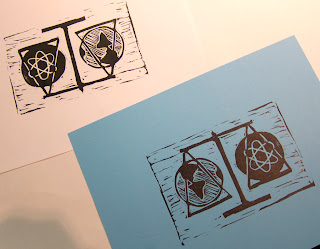
The objective of this lesson is to have each student think about and work with causes in their community or world that they feel strongly about. They will create a symbol that will represent and advocate for the promotion of that cause and learn how to create that message using beginning printmaking techniques. This lesson will have students discuss a cause of their choice with a peer and allow them to create multiple works of art from it.

Age: This was created for adults but can be taught to middle school students and older. I would recommend that students have some background in drawing or feel comfortable doing so for the lesson.

Setting: This lesson needs an open space where students can sit at a table and have enough room to walk around. The room will be arranged with printing stations set up with different colors on them. Students can carve at their seats but also get up to get paper and work at the print stations. A drying rack or a space to hang or set the prints to dry is needed. For public schools, the pace can be slowed down over a week.  One or two days can be set apart just for printing.

Special considerations: Depending on the age and maturity of students the instructor should remind the participants to be sensitive when discussing other peoples causes. They should be non-judgmental and create an environment of support. Carving tools are sharp, so safety precautions must be discussed and followed.

                                                          Materials:
 Student materials: image from home, journal or paper for notes/sketch, soft linoleum block (4 x 5 in or larger) several sheets of paper various colors, printmaking ink (black or various colors), carving tools (enough for each student), damp sponges to clean fingers, paper towels, brayers (rollers), paper to cover the tables, wax paper or clear transparency to roll ink on, scissors and masking tape. Optional: baron, drying rack, tracing paper to transfer drawings.
Teacher materials: samples prints, materials for demonstrations and posters.


Activities:

        Preparatory activities: Ask students to find an image that represents an issue that they feel strongly about bring it to class.
      Introductory activities: Welcome and share the intention of the workshop. Share the image they selected and why. Is there any experience that influenced the selection of this image?
    Think, Pair, Share: With a partner students will brainstorm and ask, what the world would look like if the issue was resolved? What symbol would represent what they would want to see in the world?   Students will begin to sketch their ideas in a journal or on a paper.

·     I will show a few examples (printed out) of symbols that could represent a cause. We can discuss these focusing on how they are sending their message. I will let them know at this time to consider how much positive and negative space they are using and to try to keep it balanced.      Transition into the demonstration on how to work with linoleum. This includes, explaining how the tools work and safety using step-by-step posters. Students can take notes in their journals.


Sample of tool and safety poster
·      Students will sketch an idea of the symbol that they will print, draw it or transfer it to their linoleum and begin to carve it. The teacher should carefully monitor this step for safety and to assist students.
·      
     Teacher will give a demonstration on printing the linoleum and reviewing the set up.


                    The teacher will also review the types of techniques and paper that can be used.
-   Rainbow roll- using two color inks on one block. Adding color on the paper then printing on top once it has dried
-  Chine-collĂ©- gluing thin paper under the print to add color
-   Ghost print- printing repeatedly until the ink fades
Students will being printing


       Closing- As a group we will discuss the challenges and successes they had during the workshop. They will describe the symbol that was chosen and share a print that was successful. In order to begin to share the message of their symbol students will select one of the many prints they made and exchanging of a print with each other.
           Follow up options- The teacher can demonstrate how to convert the image into a flyer for distribution using Adobe photoshop or other available programs.


·